Elf Subrace:
Ashen Elf
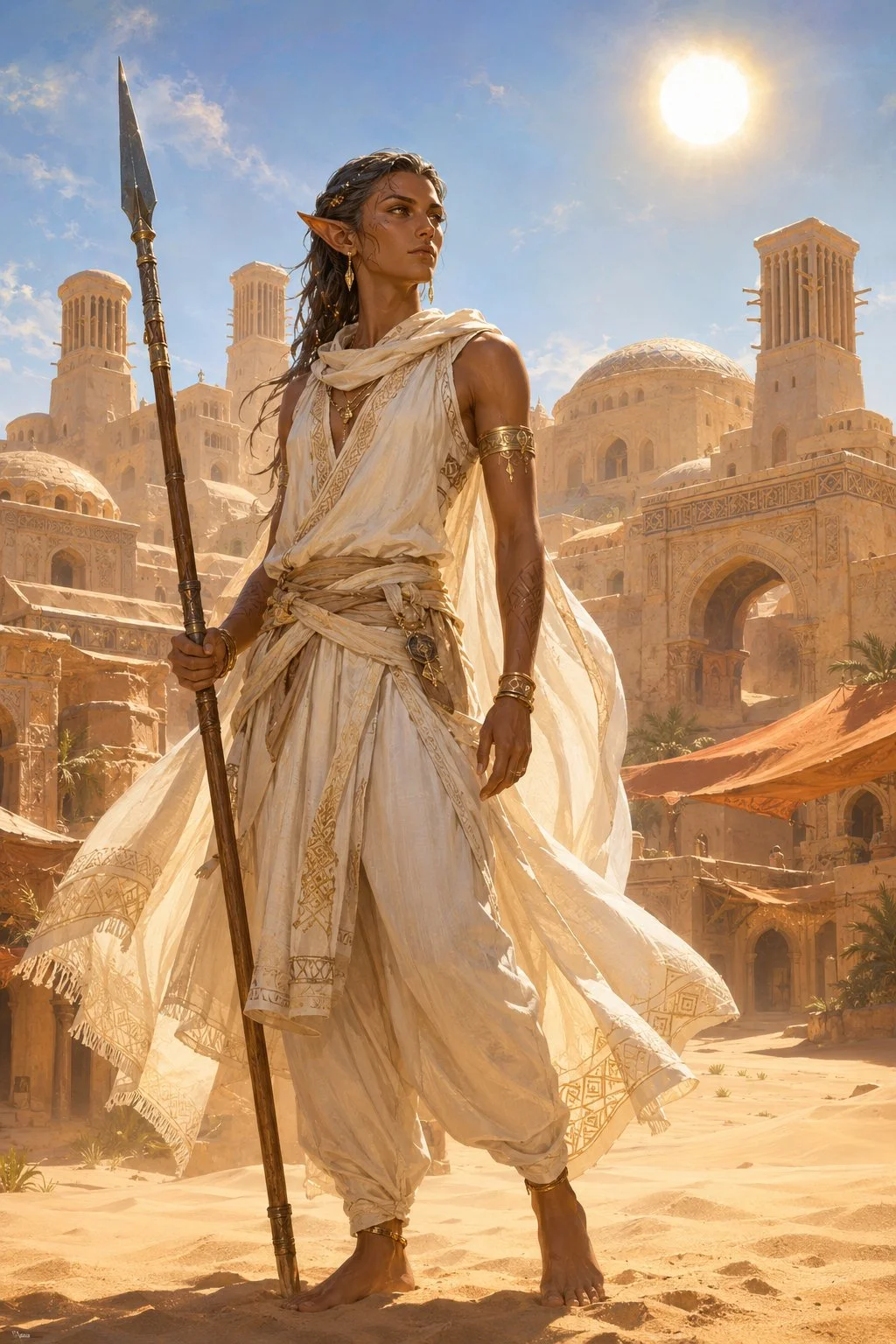
When the Kalathi Dominion fell millennia ago, the peoples it had enslaved scattered across Tarron in search of new homes and new lives. Among the newly freed elves was a group that traveled deep into the southern reaches of the continent, eventually entering a vast desert from which they could find no easy passage.
The first generations suffered terribly. Food was scarce, dependable water scarcer still, and many died before their people learned the secrets of the land. They discovered hidden aquifers and places where wells could be sunk, learned which hardy shrubs and roots were edible, followed animals to distant water, and developed methods for preserving meat and surviving journeys beneath the relentless southern sun.
They endured, and eventually endurance became mastery.
Over countless generations, these elves changed along with their culture. Their skin became darker beneath the intense sun, their bodies hardier, and the Darkvision common among other elves faded from their descendants. They became known as Ashen Elves, a name associated not with the color of their skin but with the pale dust, bleached earth, and sun-scorched wastes of the homeland they had made their own.
A Desert Made Home
Modern Ashen Elves are not a people clinging desperately to survival. The hardships of their ancestors became lessons, and those lessons became civilization.
Ashen settlements commonly rise around wells, subterranean water sources, or oases. Their homes are built from baked clay and stone, often with thick walls and rounded or domed roofs. Centuries of experimentation have taught Ashen builders how to manipulate shade and airflow, using narrow streets, interior courtyards, high vents, covered passages, and carefully positioned openings to keep buildings remarkably cool even during the hottest hours of the day.
Water is treated with profound respect. Wells and cisterns are carefully maintained, rainfall is captured whenever possible, and waste is considered both foolish and irresponsible. To poison or deliberately destroy a community's water supply is among the gravest crimes imaginable to many Ashen Elves.
Yet restraint should not be mistaken for austerity. Ashen Elves retain the elven appreciation for beauty, craftsmanship, music, and art. Their pale clay settlements may be decorated with painted tile, carved screens, colored glass, woven fabrics, polished stone, and elaborate geometric designs. Clothing is typically loose and light in color—whites, creams, pale tans, and other shades suited to reflecting the desert sun—while embroidery, jewelry, and woven patterns provide color and individuality.
Ashen beauty is rarely wasteful. It is beauty created from what the land provides.
Children of the Open Sky
Ashen Elves understand the desert in ways outsiders rarely can. A nearly invisible change in vegetation can reveal underground water. The behavior of birds may betray an oasis miles away. A shift in the wind can warn of an approaching sandstorm long before its clouds become visible.
Hunting remains an important part of Ashen life. Meat forms a significant portion of their traditional diet, supplemented by edible desert plants, roots, fruits, seeds, and whatever crops can be raised around permanent water. Spears and javelins serve equally well in hunting and warfare, while compact bows are practical in a land where suitable timber is precious.
Generations of scarcity have also left Ashen Elves exceptionally resilient. They can survive on less food and water than most peoples and endure heat, hunger, and prolonged travel with remarkable determination.
Beyond the Wastes
The desert is no longer a prison.
Ashen Elves have known routes beyond their ancestral homeland for generations, and merchants, explorers, warriors, scholars, and adventurers regularly travel throughout Tarron. Some settle permanently elsewhere, while others eventually return home.
Those who leave often discover that the wider world is every bit as strange to them as their homeland is to outsiders. Forests can seem impossibly dense, cold winters brutally unpleasant, and endless rain almost comically excessive.
Still, most Ashen Elves who remain in the south do so by choice. The desert that nearly destroyed their ancestors has become a place of cities, families, traditions, and memories.
It is not merely the place where the Ashen Elves survive.
It is home.